

How it works
- Your customer pays into a fresh address created for that one payment. No two payments share an address.
- Taberna moves the money on-chain to your payout wallet, deducting the processing fee in the same transaction.
- It lands in your wallet, usually within a minute. It is yours immediately — there is nothing to claim.
Where the money goes
To the payout address you registered for that network. If a customer pays in USDC on Base, it goes to your Base address; if they pay in SOL, it goes to your Solana address. See Payout wallets. You receive the payment amount minus your processing fee. See Fees.Who holds what, and for how long
Being precise about this, because it matters. The one-off address your customer pays into is generated by Taberna, and Taberna holds its key in encrypted storage. Money sits at that address for about thirty seconds before it is forwarded to you. The key itself is kept after that. Taberna re-checks used deposit addresses every six hours for the first thirty days, because money genuinely does turn up late — a customer re-sends, or an exchange releases a withdrawal hours after the fact. Keeping the key is what lets that money still reach you instead of being stranded at an address nobody can open. So the honest version is: Taberna can move funds that arrive at the specific addresses it created for your payments, and does so automatically. Anything already in your payout wallet is entirely beyond our reach — we do not have its key and never see it. What this arrangement buys you is that your real wallet address is never shown to buyers, and no two payments share an address.Reading the payout status on an order
Open any order in the dashboard and each payment shows a settlement status in plain English: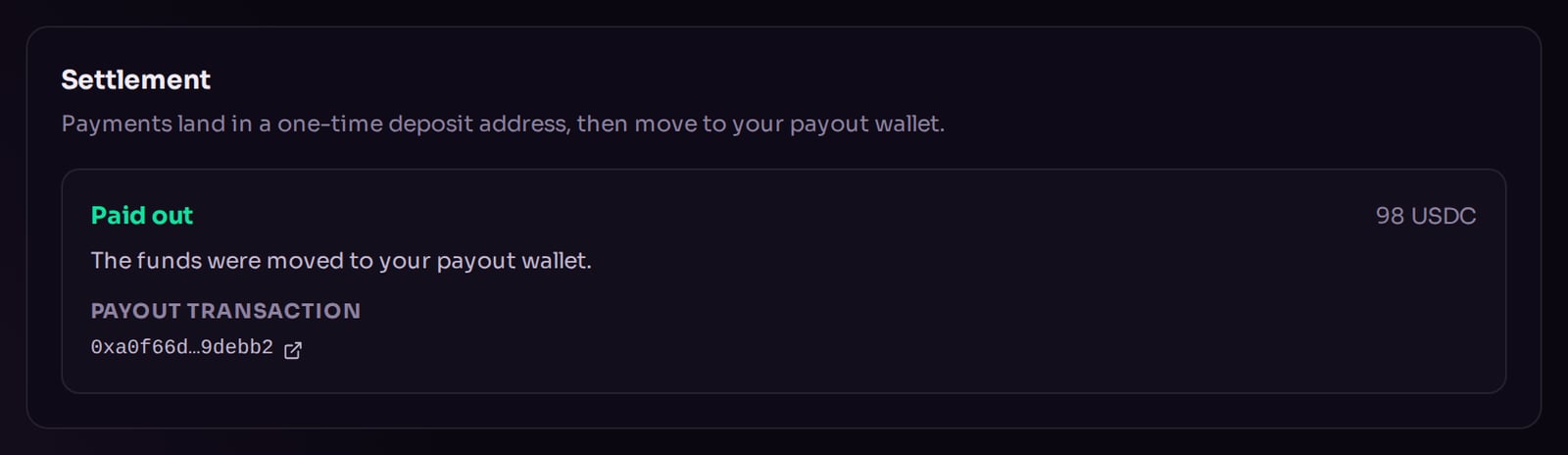
The settlement panel on an order, showing a completed payout and its on-chain transaction.
Money that arrives late, or that falls short of the amount asked for, is still
forwarded to you. Taberna does not strand funds at a deposit address because the
order did not complete.
What to read next
Fees
What is deducted, and by whom.
Orders and payments
Reading the orders list and an order’s payments.